Founded in 1989, the Human Rights Advocates Program (HRAP) is a unique and successful model of human rights capacity building. HRAP capitalizes on its affiliation with Columbia University and its location in New York City to provide grassroots leaders the tools, knowledge, access, and networks to promote the realization of human rights and strengthen their respective organizations.
HRAP’s comprehensive program of advocacy, networking, skills-building, and academic coursework provides advocates the opportunity to hone practical skills, develop a deeper understanding of human rights, and foster mutually beneficial relationships with organizations and individuals in their respective fields.
Recent Program Reports are available for download. Read the 2010 Report or 2009 Report.
Program Overview
“HRAP stands at the intersection of human rights theory and practice. For me, HRAP provided a quantum leap in my quest to acquire the knowledge, skills and core competencies to engage meaningfully in shaping the globalization debate, its processes and outcome in favor of human rights. From the highly focused advocates’ seminars, the academic courses from Columbia faculties, the educative field trips, the high profile Washington DC trip to the very practical fundraising classes, all aspects of the HRAP experience are highly participatory, result oriented and very rewarding. It is an experience of a lifetime, my expectations have been surpassed!”
– Chukwumuanya Igboekwu, Nigeria, 2006 HRAP Advocate
After completing the intensive four-month program, Advocates are able to more effectively lobby for their causes and address the human rights concerns of their community. The comparative advantages of the Human Rights Advocates Program are its:
- Comprehensive program of skills-building, networking, advocacy, and academic coursework
- Emphasis on individual and organizational capacity building
- Affiliation with Columbia University and location in New York
Skills-Building
Advocates attend a number of skills-building workshops led by staff from organizations including Human Rights Watch and Amnesty International. The workshops strengthen their effectiveness as individual advocates and allow them to build stronger organizations in their respective home countries. Topics include fundraising, campaign strategy, advocacy tools, media relations, stress management and research and documentation.
Networking and Collaborative Relationships
Organizations and Policy-makers
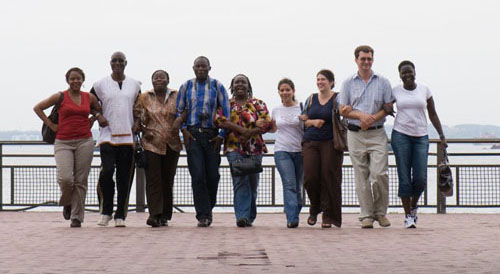
The 2010 Advocates concluded their orientation week with a visit to the Statue of Liberty and Ellis Island. Photo by Alan Orling.
Throughout the four-month program, Advocates are able to meet with a range of human rights organizations, international institutions, foundations, donors, and policymakers that are based in New York City. Each year, Advocates also participate in a networking and advocacy trip to Washington DC.
During group and individual meetings, Advocates share their unique grassroots knowledge and learn more about the strategies and best practices of other human rights organizations. These meetings also often lead to joint projects and funding opportunities.
Student Life in New York City
HRAP integrates Advocates into various aspects of student life. Advocates reside at International House with international and US students and participate in a range of social, learning and cultural activities organized by International House and Columbia University.
“Meeting John Caulker, one of the Advocates of 2007, was in all respects a life-altering experience. Having met a few times for coffee, we soon realized we had many interests in common. I had more academic experience in some areas, whereas John had an amazing practical experience, implementing human rights work in West Africa. He opened my eyes to his native Sierra Leone and invited me to work with him there. This was what eventually led to me founding an organization working with peacebuilding in the country and today our organizations are partnering in our work. In short, the Advocates Program offers invaluable possibilities not only for those visiting Columbia from abroad, but certainly also for us students.”
– Jakob Lund, SIPA, MIA 2009
Other Advocates
The four-month program gives Advocates time and space to reflect on their work and share their experiences and insights with one another. HRAP also facilitates relationship-building among alumni of the program. For example, through the HRAP Alumni Online Forum, Advocates can share updates and support one another in their efforts to promote human rights.
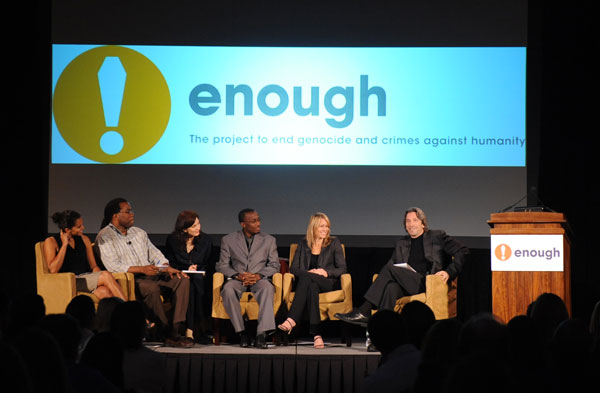
In September 2008, Advocate Dr. Roger Luhiriri joined panel discussions in NYC and DC to discuss extreme violence against women in the Congo.
Unique Access to Advocacy Forums
Advocates are frequently invited to participate and attend panel discussions and lectures, both at Columbia University and throughout the United States. During such events, Advocates are able to raise public awareness and promote the work of their organizations.
Columbia University
Advocates audit at least two graduate level courses at Columbia University. Advocates attend classes at the School of International and Public Affairs, the Law School, the Mailman School of Public Health, the Graduate School of Arts & Sciencees, the School of Social Work, Teachers College and Barnard. Each Advocate is assigned a Columbia University professor as mentor. Advocates often develop strong relationships with professors, students, and other members of the Columbia University community.
Support
The Institute for the Study of Human Rights is grateful to the following for their generous support of the Human Rights Advocates Program:
|
2011 (as of July 1, 2011) American Jewish World Service Arcus Foundation Dr. Zelma Henriques Open Society Foundations, Africa Open Society Foundations, International Women’s Program Sperry Fund Tribal Link Foundation Anonymous Anonymous |
2010 Arcus Foundation Stephen Lewis Foundation International Women’s Program of the Open Society Institute Sperry Fund Whitney M. Young, Jr. Memorial Foundation the Harriman Institute at Columbia University anonymous donor |
2009 Arcus Foundation General Service Foundation Open Society Institute- International Women's Program Open Society Institute- Public Health Open Society Institute- Sharp Sigrid Rausing Trust Sperry Foundation Whitney M. Young, Jr. Memorial Foundation |
Alumni Support
The Institute for the Study of Human Rights is very grateful to the following HRAP alumni who kindly interviewed candidates for the 2011 HRAP:
2009 Advocate Evalyne Achan
2010 Advocate Susan Aryeetey
2009 Advocate Elsadig Elsheikh
2009 Advocate Nazibrola Janezashvili
2008 Advocate Peter Mulbah
2009 Advocate Akiny Ocholla
2009 Advocate Florencia Ruiz